
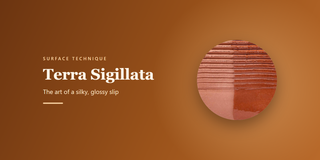
At Sheffield Pottery, we love exploring the many ways potters can achieve beauty and finesse in their work. One classic technique that has captivated ceramic artists for centuries is terra sigillata—a refined, silky slip that creates smooth, glossy surfaces without the need for glaze.
There's something magical about terra sigillata. It transforms ordinary clay into surfaces that catch light like satin, feel smooth as river stones, and display colors with a depth that commercial glazes can't quite replicate. Best of all, this ancient technique requires no special equipment—just clay, water, patience, and a willingness to slow down and let particles do what physics naturally wants them to do.
What is Terra Sigillata?
Terra sigillata (Latin for "sealed earth") is an ultra-fine clay slip that creates a polished, almost glossy finish when applied to greenware and burnished. Unlike regular slip, which contains clay particles of all sizes, terra sigillata consists only of the finest particles—so fine they remain suspended in water while heavier particles sink.
The Science Behind the Shine
Clay particles come in various sizes. Regular clay contains everything from relatively large particles (still microscopic, but comparatively huge) down to the finest colloidal particles. When you mix clay with water and let it settle, gravity sorts these particles by weight:
- Bottom layer: Coarse particles that settle quickly
- Middle layer: Medium-sized particles
- Top layer: Ultra-fine particles that remain suspended longest
That top layer—those ultra-fine particles—is terra sigillata. When applied to pottery and burnished, these tiny particles align parallel to the surface, creating a smooth, reflective finish that resembles the sheen of polished stone.
Historical Context
Terra sigillata dates back to ancient Roman pottery, though similar techniques appeared in Greek and Etruscan ceramics even earlier. Roman potters created the famous red-glossed Samian ware using refined slips and burnishing techniques that we now recognize as terra sigillata.
What's remarkable is that ancient potters achieved these effects without understanding particle physics—they simply observed that certain clay preparations, when applied and polished, created beautiful surfaces. The technique was largely forgotten for centuries and rediscovered by modern potters in the mid-20th century through archaeological research and experimentation.
Today, terra sigillata remains a favorite among contemporary studio potters for its subtle, elegant surface effects that honor clay's natural beauty rather than covering it with glaze.
How to Make Terra Sigillata: A Step-by-Step Guide
Creating terra sigillata is surprisingly simple but requires patience. You're not forcing anything—you're allowing natural particle separation to occur.
Step 1: Choose Your Clay
Use a smooth, refined clay body. The finer your starting clay, the better your final terra sig will be.
Color considerations:
- Low-iron or white clay: Creates lighter, cream to white surfaces. Excellent for pastel colorants or as a neutral base
- Red or terracotta clay: Produces warm orange-red tones reminiscent of ancient Roman pottery
- Buff or tan clay: Creates earthy, neutral tones
Many potters use the same clay body they're throwing with, ensuring perfect compatibility. Others experiment with different clays to achieve specific colors.
Step 2: Mix and Slake
Basic ratio: Start with 1 part dry clay to 3-4 parts water by weight. This creates a very thin slip.
Process:
- Add dry clay to water (not water to clay—prevents lumps)
- Let soak for several hours or overnight
- Mix thoroughly with a drill mixer or by hand
- Strain through 80-mesh screen to remove any large particles or debris
You want a consistency like whole milk—thin enough to pour easily, thick enough to still be obviously clay.
Step 3: Add Deflocculant (Optional but Recommended)
What deflocculants do: They prevent clay particles from clumping together, keeping fine particles suspended longer and making the final terra sig more fluid and easier to apply.
Common deflocculants:
- Sodium silicate (water glass): Most common, widely available
- Darvan 7 or 811: Modern commercial deflocculants specifically for clay
- Calgon (sodium hexametaphosphate): Household water softener that works as a deflocculant
How much to add: Start with 1/4 teaspoon per quart of slip. Add gradually while mixing, testing consistency. Too much deflocculant makes slip too thin; too little means particles clump.
Testing: Properly deflocculated slip feels slippery, almost slick, and flows smoothly when poured.
Step 4: Let It Settle
This is where patience matters. Pour your deflocculated slip into a tall container—a clear one lets you watch the process, which is oddly satisfying.
Settlement timeline:
- After 24 hours: Heaviest particles have settled to the bottom
- After 48-72 hours: Clear separation visible—bottom layer dense, top layer still cloudy
- After 1 week: Maximum separation achieved
You'll see distinct layers:
- Bottom (1/3 to 1/2): Dense, thick clay—discard or use for other purposes
- Middle (variable): Transition zone—can be re-settled
- Top (1/3 to 1/2): Your terra sigillata—smooth, fluid, finest particles
Step 5: Decant the Top Layer
Carefully siphon or pour off the top layer without disturbing the settled material below. This is your finished terra sigillata.
Storage: Keep terra sig in sealed containers. It remains usable for months if properly stored. Stir gently before each use—don't shake vigorously, which reintroduces larger particles.
Consistency: Finished terra sig should be slightly thicker than skim milk but thinner than whole milk. If too thin, let settle again and decant more carefully. If too thick, add small amounts of water.
Applying Terra Sigillata: Techniques and Tips
Application technique significantly affects final results. Terra sig isn't like glaze—it requires different handling.
When to Apply
Leather-hard to bone dry: Terra sig works best on greenware. Leather-hard allows some absorption; bone dry gives maximum smoothness but requires careful handling.
Most potters prefer firm leather-hard—clay is dry enough to handle confidently but still absorbs terra sig readily.
Application Methods
Brushing:
- Use soft brushes (natural hair or soft synthetic)
- Apply thin, even coats
- Brush in consistent directions for each layer
- Let each coat dry before applying next
- 3-7 coats typical for good coverage
Sponging:
- Natural sponge works best
- Dab and smooth rather than wiping
- Creates very even coverage
- Particularly good for textured surfaces
Dipping:
- Quick, even coverage
- Works well for small pieces or production work
- Requires enough terra sig to submerge pieces
- May need 2-3 dips for adequate coating
Spraying:
- Most even application possible
- Requires spray equipment
- Thin, numerous coats build to final finish
- Professional results but more equipment-intensive
The Burnishing Process
This is where terra sigillata becomes truly special. Burnishing aligns those fine particles and creates the characteristic sheen.
When to burnish: When terra sig is dry enough not to smear but not completely bone dry—usually 15-30 minutes after final coat. The surface should feel cool to touch (moisture still present) but not wet.
Burnishing tools:
- Smooth stones: River rocks, polished agates
- Metal spoons: Back of spoon provides smooth, hard surface
- Pottery ribs: Smooth plastic or metal ribs
- Specialized burnishing tools: Available from pottery suppliers
Technique:
- Apply consistent pressure (firm but not crushing)
- Use smooth, overlapping strokes
- Work in sections, completely burnishing each before moving on
- Continue until surface develops visible sheen
- Re-burnish if sheen fades as piece dries further
The sound test: Properly burnished terra sig produces a slight squeaking sound as you burnish—that's particles aligning.
Creative Applications and Effects
Terra sigillata's versatility allows endless experimentation.
Decorative Techniques
Masking: Apply terra sig to selected areas only. Mask with wax resist, latex, or tape to create patterns. Remove masking after terra sig dries to reveal contrasting surfaces.
Layering colors: Mix oxide colorants into separate batches of terra sig (iron oxide for reds, cobalt for blues, copper for greens). Apply in layers or patterns for color variation.
Sgraffito: Apply thick terra sig layer, let dry slightly, then carve through to reveal clay beneath. Burnish remaining terra sig for contrast between matte carved areas and glossy surface.
Burnished patterns: Selectively burnish only portions of terra sig coating. Burnished areas shine; unburnished areas remain matte. Creates subtle surface variation.
Terra sig over texture: Apply to carved, stamped, or textured surfaces. Pooling in recesses creates depth while burnished high points catch light.
Combining with Other Techniques
Under transparent glazes: Terra sig as a base layer under clear or translucent glazes adds depth and richness. The burnished surface shows through, creating complex surface quality.
With underglazes: Apply underglazes over burnished terra sig for smooth, controlled surfaces perfect for detailed decoration.
Smoke firing and pit firing: Terra sig surfaces respond beautifully to smoke firing. Carbon from smoke creates dramatic black markings on the burnished surface while leaving matte clay areas lighter.
Saggar firing: Protected by the saggar, terra sig surfaces develop rich, varied colors from vapor and flame patterns.
Firing Terra Sigillata
Firing preserves your carefully burnished surface—or ruins it. Temperature and atmosphere matter.
Temperature Considerations
Low-fire (Cone 06-04, 1828-1940°F):
- Best temperature range for terra sig
- Preserves maximum sheen and surface quality
- Clay particles remain sintered but not over-matured
- Colors stay truest to original
Mid-range (Cone 5-6, 2167-2232°F):
- Terra sig survives but loses some sheen
- Higher temperatures begin to matte the surface
- Still functional but less dramatic shine
- Better under transparent glazes at this range
High-fire (Cone 10+, 2345°F+):
- Generally not recommended for bare terra sig
- Surface becomes matte or disappears entirely
- Only use if applying transparent glaze over terra sig
Atmosphere Effects
Oxidation (electric kiln):
- Standard choice for terra sig
- Preserves colors accurately
- Reliable, predictable results
- Clean, bright surface
Reduction (gas kiln):
- Can create interesting color variations
- Iron-bearing clays develop richer reds or blacks
- Less predictable but potentially stunning
- Requires experience to control
Smoke/pit firing:
- Exceptional effects with burnished terra sig
- Carbon creates dramatic black patterns
- Contrast between carbon-marked and clean areas
- Unpredictable but often beautiful
Troubleshooting Common Problems
Terra sig flaking off:
- Cause: Applied too thickly, incompatible clay, or not burnished when properly dry
- Solution: Thinner coats, ensure clay compatibility, burnish at right moisture level
Uneven sheen:
- Cause: Inconsistent burnishing pressure or timing
- Solution: More even pressure, burnish entire surface at same dryness level
Dull, matte surface after firing:
- Cause: Fired too hot, over-burnished, or terra sig too thick
- Solution: Lower firing temperature, lighter burnishing, thinner application
Cracking or crazing:
- Cause: Terra sig shrinks differently than clay body
- Solution: Use same clay for terra sig as piece, or add small amount of piece's clay to terra sig
Color not as expected:
- Cause: Oxidation level, firing temperature, or clay impurities
- Solution: Test fire samples, adjust temperature, use purer clay
Why Potters Love Terra Sigillata
Beyond the technical process, terra sigillata offers something deeper—a connection to clay's natural beauty and pottery's ancient traditions.
Aesthetic Appeal
It honors the clay. Rather than covering clay with opaque glaze, terra sig enhances natural clay color and form. The finish celebrates rather than conceals.
Subtle sophistication. Terra sig surfaces have quiet elegance. They don't shout; they whisper. Light moves across burnished surfaces in ways that feel organic and alive.
Tactile pleasure. Burnished terra sig feels extraordinary—smooth, silky, almost soft despite being fired ceramic. People instinctively want to touch it.
Versatility
Works with any form:
- Hand-built vessels
- Wheel-thrown pottery
- Sculptural pieces
- Tiles and architectural elements
- Functional ware
- Pure art objects
Compatible with many techniques:
- Can be sole surface treatment
- Works under glazes
- Pairs with resist decoration
- Enhances carved or textured surfaces
- Responds beautifully to alternative firing
Practical Benefits
No glaze required. For low-fire decorative work, terra sig eliminates glaze costs and glaze-firing complications.
Minimal equipment needed. Unlike glazing, which requires kiln furniture, proper ventilation for some glazes, and extensive testing, terra sig needs only clay, water, and patience.
Forgiving of experimentation. Unlike glaze chemistry, which can produce toxic results if done wrong, terra sig experiments are inherently safe—it's just refined clay.
Sustainable. Uses minimal materials, creates little waste, and can be made from scrap clay and water.
Getting Started with Terra Sigillata
If you've never worked with terra sig, start simple.
First project suggestions:
- Small burnished bowls or cups
- Decorative tiles
- Simple hand-built vessels
- Test tiles to explore color and technique
What you'll need:
- Clay (start with clay body you know)
- Water
- Deflocculant (optional but helpful)
- Tall settling container
- Soft brushes or sponges
- Burnishing tools (smooth stones or spoons)
- Patience
Time investment:
- Making terra sig: 15 minutes active work, 3-7 days settling
- Applying: 30 minutes to several hours depending on piece size
- Burnishing: 15 minutes to 2 hours per piece
Expected results: Your first attempts may not achieve mirror-perfect burnish, but even imperfect terra sig creates beautiful, unique surfaces. Each piece teaches you something about timing, pressure, and technique.
Final Thoughts
Terra sigillata represents pottery at its most elemental—clay, water, and patient refinement creating beauty without complex chemistry or expensive materials. It's a technique equally accessible to beginners and endlessly refineable by experienced potters.
Whether you're creating minimalist vessels, decorative tiles, or experimental sculptures, terra sigillata offers a timeless way to bring smooth, luminous finishes to your work. It connects you to ancient pottery traditions while remaining completely contemporary in application.
At Sheffield Pottery, we encourage potters to explore the subtle magic of terra sigillata. We carry the clays, deflocculants, and tools you need to begin experimenting with this beautiful technique.
It's a small step in technique that can make a profound difference in the final look of your ceramics. Try it. You might discover that this ancient surface treatment becomes an essential part of your pottery vocabulary.